Skip to content

Starter guide

Lumberjack Sports

Chop, saw, throw and logroll against the clock.

Lumberjack sports turn old logging-camp skills into timed races: chopping through a log you are standing on, pulling a six-foot crosscut saw through a pine block, sticking an axe in a bullseye from 20 feet, and staying upright on a spinning log while someone tries to dump you in the water. You do not need to own anything to try it. Axe-throwing venues and pool logrolling classes hand you the equipment, and clubs and college woodsmen teams lend axes, saws and protective gear to new members. Technique beats size in every event, and a stopwatch tells you exactly how much you have improved.

Difficulty
moderate learning curve
Startup cost
$30-$300
First result
A stuck axe or a few seconds upright on a log in your first session; a timed chop or saw cut after 3 to 4 coached practices
Axe-box total$0.00
Two competitors balancing on a floating log at a lumberjack show, water spraying around them, with a log-cabin set behind
01

Pick a first event

Four ways in, each coached on its own

Axe ThrowingThe easiest way in. League venues throw a hatchet of about 1.5 lb from 12 to 15 feet. Lumberjack shows throw a full-size double-bit axe from 20 feet at a 36-inch target whose 4-inch bullseye scores 5. Most people stick a throw inside the first hour.

Start here

Book a lane at an axe-throwing venue this week and ask the coach to watch your release. If you like it, sign up for the venue's next league season.

Find an axe-throwing venue
ChoppingIn the underhand chop you stand on a horizontal log about 12 inches thick and cut it in two between your feet, half from each side. The standing block chop is the same race on an upright log. Both need a coach and protective gear from the first swing.

Start here

Find a club, a college woodsmen team or a weekend clinic and take your first swings there with a coach, on their wood, in their protective gear. Buy a practice axe only after someone has shown you how to stand.

See how the underhand chop works
SawingIn the single buck one person pulls a crosscut saw about six feet long through a pine log 16 to 20 inches across. The double buck and the mixed-pair Jack and Jill put a sawyer on each handle. It is the safest wood event to learn and the hardest on your lungs.

Start here

Ask a club for a turn on the double buck first: an experienced partner on the other handle sets the rhythm while you learn to pull. Read the Forest Service saw manual before you buy a saw of your own.

Read Saws That Sing
LogrollingTwo people stand on one floating log and spin, stop and reverse it with their feet until one falls in. Matches are best of three or five falls. Pool programs teach on a light synthetic log with removable fins that slow the spin, so kids and adults learn in the same class.

Start here

Check the program map for a pool or lake near you and book a beginner class. Bring a swimsuit and shoes that can get wet.

Find a logrolling program

Open a card to see what to do first. Each one ends in a button that adds that event's gear to the kit.

02

Your first month

Close-up of a scarred wooden axe-throwing target with hand-drawn scoring rings numbered two to four
Scoring rings on a well-used target
03

Choosing an axe and keeping it sharp

  • A practice chopping axe is a full-size single-bit axe: a 3.5 lb head on a hickory handle 28 to 36 inches long. Shorter handles suit shorter choppers and the underhand chop.
  • Check the handle when it arrives. The grain should run parallel to the head with no knots or cracks, and the head should sit tight with no gap at the eye.
  • Sight down the edge. It should line up with the center of the handle, and the cheeks behind it should be even on both sides. Thick factory grinds bounce out of the wood until they are filed thinner.
  • Racing axes are wide, thin, hand-ground and cost several hundred dollars. They chip on knots and frozen wood, so clubs save them for competition and practice on cheaper axes. Do not buy one in your first year.
  • Before every session, check that the head is tight and touch up the edge with a file. A sharp axe bites where you aim it and a dull one glances off, which is how shins get hit.
  • A throwing hatchet wants the opposite grind: a keen edge that is not razor thin, so it survives hitting the floor and the target frame.
  • A crosscut saw cuts fast only when its teeth are set and its rakers filed, which is specialist work. Keep a new saw oiled and hung up, and ask the club who sharpens theirs.
An axe with a curved wooden handle sunk in a chopping block on dry grass under a dark sky
A single-bit axe parked in the block
04

Safety rules that are not optional

  • Never chop without foot and shin protection. Competition rules require it: chainmail socks or leggings for the underhand chop, and leg protection for the standing block. Clubs lend it to beginners.
  • Chop and saw only with a second person present. Keep everyone else at least two axe lengths away and out of the line of the swing.
  • Secure the log before you step on it. Underhand blocks are held in a stand or pinned so they cannot roll under your feet.
  • For throwing, the backstop matters more than the target: a wall or fence behind and beside it, nobody downrange, and no one retrieves until every axe has been thrown. Axes bounce back along the ground, so wear closed-toe shoes.
  • Carry an axe by the handle just below the head with the edge pointing down and away, and cover the edge when it is not in use.
  • Wear eye protection for chopping. Chips leave the cut at face height.
  • Logroll in waist-deep water with a clear bottom, fall away from the log and never onto it, and keep non-swimmers in life jackets.
  • Chainsaw events (stock saw and hot saw) need chaps, hearing protection and formal saw training first. Nobody starts there.
05

What trips beginners up

  • Swinging hard and missing the line. Two accurate hits remove more wood than five wild ones.
  • Pushing the saw. A crosscut saw cuts on the pull, and pushing buckles the blade and jams it in the cut.
  • Expecting to stay on the log. Most first-timers last two or three seconds. Small fast steps, bent knees and eyes on the far end of the log get you to ten.
  • Changing the throw when the distance is wrong. If the handle hits first, move your feet a few inches forward or back before you alter your arm.
  • Sore hands. Blisters and a tired grip arrive before fitness does, so keep early wood sessions under an hour.
  • Springboard, pole climbing and hot saw get the TV time. They come after a season or more of basic chopping and sawing.
A hatchet stuck in a log-round target with a red painted center, hung on a scorched wooden wall
A hatchet stuck beside the red center
06

Time commitment

Clubs and college teams usually practice once or twice a week for one to two hours, which is enough to be ready for novice classes within a season. Competitions run from late spring through early fall at fairs, logging festivals and dedicated shows, with college meets in fall and spring. Axe-throwing leagues run year-round, one evening a week, and logrolling moves indoors to pools for the winter.

07

Where to learn

A club or college woodsmen team is the surest teacher. To find one, ask a university forestry department or the organizers of the nearest lumberjack show. The Lumberjack World Championships in Hayward, Wisconsin, posts results and broadcast replays that show good technique in every event. The US Log Rolling Association publishes the rules and tournament calendar for logrolling and boom running. The discipline guides from the professional chopping and sawing series walk through each event cut by cut, and the Forest Service crosscut saw manual covers what a club coach may not have time to explain.

Black-and-white photograph of two sawyers pulling a crosscut saw through the trunk of a large pine
Two sawyers on a crosscut saw
08

How the kit is put together

The one thing every beginner pays for is instruction: a lane, a class or club dues. Everything else depends on the event, so the kit is split into four add-ons and you switch on the one you are practicing. Throwing and logrolling cost the least to equip. Chopping stays affordable as long as you use a practice axe, and a crosscut saw is the biggest single purchase here, which is why most people saw on club saws for their first season. Practice wood is not on the list. Clubs buy blocks by the truckload, and for home practice a firewood dealer, sawmill or tree service is the usual source of green, knot-free logs. Chainmail leg protection and synthetic logrolling logs are specialist items that come later, through the club or program you train with.

A red-headed axe resting in a stump in front of a stacked log pile
09

Pack the axe box

Every line, with its options side by side

The first line is not something you buy online: it is the lane, class or club that teaches you. Every other line belongs to one event and joins the kit when you switch that event on, here or in the cart. Clicking a card selects it, and clicking the selected card again takes that line out.

Line 01

Intro session, class or club membership

Essential · Instruction

Every event here is learned under supervision first, and a venue, class or club supplies the axes, saws, logs and protective gear you would otherwise have to buy.

Not sold on Amazon

Not sold on Amazon. Look for an axe-throwing venue affiliated with a national league, a pool or lake logrolling program with trained instructors, or a lumberjack sports club or college woodsmen team that takes novices. A lane or class typically runs $25 to $50 a session, and club dues are often under $150 a year. For chopping, confirm the club lends chainmail foot and shin protection.

Line 02

Throwing hatchet

Situational · Core equipment · Axe Throwing add-on

League nights supply axes, but your throw only becomes repeatable when you practice with one hatchet whose weight and handle length you know.

budget
Cold Steel Competition Throwing Hatchet, 16"

Cold Steel Competition Throwing Hatchet, 16"

4.4(997)

$30.89

View on Amazon
mid-range
The Competition Thrower: World Axe Throwing League Premium Competition Throwing Axe with Throwing Hatchet Hickory Wooden Handle

The Competition Thrower: World Axe Throwing League Premium Competition Throwing Axe with Throwing Hatchet Hickory Wooden Handle

4.5(1.5K)

$49.99

View on Amazon
premium
The Bad Axe: World Axe Throwing League Premium Competition Throwing Axe with Throwing Hatchet Nylon Sheath and Hickory Wooden Handle

The Bad Axe: World Axe Throwing League Premium Competition Throwing Axe with Throwing Hatchet Nylon Sheath and Hickory Wooden Handle

4.5(294)

$79.99

View on Amazon

Look for a head around 1.5 lb and a straight wooden handle 14 to 17 inches long, which most leagues allow. Home practice also needs a target, which league plans build from lumberyard 2x10 boards on a 2x4 frame. The 20-foot lumberjack throw uses a double-bit axe: borrow the club one for that.

Line 03

Axe sharpening puck

Situational · Maintenance · Axe Throwing add-on

A hatchet that hits the floor and the target frame loses its edge quickly, and a dull edge bounces out of the boards. A pocket stone restores it in a couple of minutes.

budget
Lansky Puck - Dual Grit Multi-Purpose Sharpener - Blade & Tool Sharpener

Lansky Puck - Dual Grit Multi-Purpose Sharpener - Blade & Tool Sharpener

4.6(18.2K)

$13.00

View on Amazon
mid-range
DDF IohEF Axe/Hatchet Sharpening Stone 180/320 Grit with Portable Bag

DDF IohEF Axe/Hatchet Sharpening Stone 180/320 Grit with Portable Bag

4.6(3.3K)

$16.99

View on Amazon
premium
Sharp Pebble Puck/Disk - Axe/Hatchet Whetstone Sharpening Stone

Sharp Pebble Puck/Disk - Axe/Hatchet Whetstone Sharpening Stone

4.6(1.7K)

$34.99

View on Amazon

Use the coarse side for nicks and the fine side to finish. Wet it with water or oil as the maker directs.

Line 04

Full-size single-bit practice axe

Situational · Core equipment · Chopping add-on

This is the axe you chop practice blocks with while the club's racing axes stay in their boxes. A general-purpose felling pattern is tough enough to survive knots and beginner misses.

budget
Truper 30520 3-1/2-Pound Single Bit Michigan Axe, Hickory Handle, 35-Inch

Truper 30520 3-1/2-Pound Single Bit Michigan Axe, Hickory Handle, 35-Inch

4.1(54)

$35.99

View on Amazon
mid-range
3.5 lb. Single Bit Axe, 36" Curved Handle, Made in USA

3.5 lb. Single Bit Axe, 36" Curved Handle, Made in USA

4.3(108)

$66.44

View on Amazon
premium
Council Tool Jersey Classic with Forged Bevels 32 Inch Curved Wooden Handle Sport Utility Finish (Without Sheath)

Council Tool Jersey Classic with Forged Bevels 32 Inch Curved Wooden Handle Sport Utility Finish (Without Sheath)

4.6(38)

$108.92

View on Amazon

A 3.5 lb head suits most adults. Handles of 28 to 32 inches are easier to control on the underhand chop. A 36-inch handle is the common stock length and can be cut down. Expect to file the factory edge thinner before it cuts well.

Line 05

10-inch mill file

Situational · Maintenance · Chopping add-on

A single-cut mill file thins a factory edge and takes out the nicks that knots leave. It is the touch-up tool before each session.

budget
Century Drill & Tool 4053 Mill Bastard Hand File, 10"

Century Drill & Tool 4053 Mill Bastard Hand File, 10"

4.5(136)

$13.82

View on Amazon
mid-range
Crescent Nicholson 21701N 10" Mill Single Cut Bastard File with Red Handle - Carded,Grey

Crescent Nicholson 21701N 10" Mill Single Cut Bastard File with Red Handle - Carded,Grey

4.6(117)

$18.94

View on Amazon
premium
Bahco 4-138-10-1-2 BH4-138-10-1-2 ERGO Cut 1 Mill Saw Flat File with Handle, Grey/Black/Orange, 10"

Bahco 4-138-10-1-2 BH4-138-10-1-2 ERGO Cut 1 Mill Saw Flat File with Handle, Grey/Black/Orange, 10"

4.4(19)

$42.10

View on Amazon

Clamp the axe head, push the file in one direction only and lift it on the return stroke. Count your strokes so both sides of the edge stay even.

Line 06

Safety glasses

Situational · Safety gear · Chopping add-on

Wood chips hit hard enough to scratch an eye, and they travel toward the timekeeper as well as the chopper.

budget
KLEENGUARD Indoor/Outdoor Safety Glasses, Scratch-Resistant, Wraparound, 1 pair

KLEENGUARD Indoor/Outdoor Safety Glasses, Scratch-Resistant, Wraparound, 1 pair

4.5(924)

$6.29

View on Amazon
mid-range
NoCry Clear Safety Glasses for Men and Women with Anti-Fog and Scratch Resistant Wrap Around Lenses, Adjustable Temples and Nose Pads — ANSI Z87 Certified Protective Eyewear with 100% UV Shielding

NoCry Clear Safety Glasses for Men and Women with Anti-Fog and Scratch Resistant Wrap Around Lenses, Adjustable Temples and Nose Pads — ANSI Z87 Certified Protective Eyewear with 100% UV Shielding

4.5(51.6K)

$13.99

View on Amazon
premium
3M Safety Glasses, Solus 1000, Scotchgard Clear Lens, Blue/Black Frame

3M Safety Glasses, Solus 1000, Scotchgard Clear Lens, Blue/Black Frame

4.5(7.8K)

$17.49

View on Amazon

Pick a pair marked Z87 with a wraparound lens. An anti-fog coating helps once you are breathing hard.

Line 07

Crosscut saw

Situational · Core equipment · Sawing add-on

A saw of your own lets you drill the pull stroke and build sawing fitness between club sessions. Competition racing saws are custom-made and cost many times more, so treat this as a training tool.

budget
Kings County Tools Hand Saw for Wood Cutting, 3ft

Kings County Tools Hand Saw for Wood Cutting, 3ft

4.2(11)

$168.70

View on Amazon
mid-range
Lynx 4' One Man Crosscut Saw

Lynx 4' One Man Crosscut Saw

4.4(32)

$204.99

View on Amazon
premium
Lynx 5' Two Man Crosscut Saw

Lynx 5' Two Man Crosscut Saw

4.3(56)

$249.99

View on Amazon

A one-person saw with a D handle suits solo practice. A two-person saw of 5 feet or more is closer to what the double buck uses. Saw with a club for a few weeks before buying, and keep the blade lightly oiled against rust.

Line 08

Plastic bucking wedges

Situational · Accessories · Sawing add-on

As the cut deepens, the log closes on the blade and pinches it. A plastic wedge tapped into the top of the cut holds it open and will not damage the teeth if the saw touches it.

budget
Oregon Felling Wedge, 5.5 Inch

Oregon Felling Wedge, 5.5 Inch

4.5(1K)

$7.57

View on Amazon
mid-range
UNCO- Tree Felling Wedges, 4 Pack, 5.5" & 8", Splitting Wedges with Spikes

UNCO- Tree Felling Wedges, 4 Pack, 5.5" & 8", Splitting Wedges with Spikes

4.6(1.5K)

$9.99

View on Amazon
premium
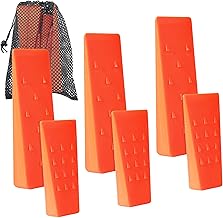
6 Pack Tree Felling Wedges with Spikes for Safe Tree Cutting – 3 Each of 8” and 5.5” Wedges with Storage Bag; 6 Felling Dogs to Guide Trees Stabilize and Safely to Ground for Loggers and Fallers

6 Pack Tree Felling Wedges with Spikes for Safe Tree Cutting – 3 Each of 8” and 5.5” Wedges with Storage Bag; 6 Felling Dogs to Guide Trees Stabilize and Safely to Ground for Loggers and Fallers

4.6(6.2K)

$15.79

View on Amazon

The short 5.5-inch size is enough for practice logs. A multi-pack is fine, since wedges get lost and chewed up.

Line 09

Water shoes

Situational · Footwear · Logrolling add-on

Synthetic training logs have a textured surface that needs a clean, grippy sole, and pools do not allow street shoes in the water.

budget
Water Shoes for Men Women Barefoot Quick Dry Aqua Socks Slip On

Water Shoes for Men Women Barefoot Quick Dry Aqua Socks Slip On

4.3(148.8K)

$5.88

View on Amazon
mid-range
Water Shoes for Women Men - Barefoot Quick-Dry Aqua Socks | Lightweight Swim Shoes for Surfing, Swimming, Beach Sports, Kayaking, Diving | Non-Slip Design

Water Shoes for Women Men - Barefoot Quick-Dry Aqua Socks | Lightweight Swim Shoes for Surfing, Swimming, Beach Sports, Kayaking, Diving | Non-Slip Design

4.5(29.3K)

$16.99

View on Amazon
premium
Water Shoes for Men and Women Quick Dry Barefoot Hiking Swim Footwear

Water Shoes for Men and Women Quick Dry Barefoot Hiking Swim Footwear

4.4(23.5K)

$29.99

View on Amazon

These listings come in both men's and women's sizes, so check the size chart. Choose a snug closed-toe pair with a thin, flexible sole so you can feel the log.