Skip to content

Starter guide · Raw bar at home

Oyster Shucking

Open live oysters cleanly at home and serve your own raw bar.

Oyster shucking is the knack of opening a live oyster with a short, stubby knife: you find the hinge, twist it open, cut the meat free and keep the briny liquor in the shell. You already have most of what you need: a kitchen counter, a fridge, a bowl of ice and a dish towel. Add a proper oyster knife and a cut-resistant glove and you can buy a dozen from a fish counter and shuck them the same evening. The first few take a minute each and some patience; by the end of a few dozen, the twist becomes a feel rather than a fight. People love it because oysters bought whole cost a fraction of raw-bar prices, every growing area tastes different, and opening a platter for friends is a small party trick that feeds everyone.

Difficulty
Moderate learning curve
Startup cost
$45 to $140
First result
Your first opened oyster in your first session, a clean dozen with the liquor intact within three or four sessions
Raw-bar total$0.00
01

What a shucking session looks like

Most of the hobby happens around the knife work. You buy from a fish counter or a farm, keep the oysters cold, and set out a tray of crushed ice before you open the first one. Oysters are farmed year-round on the Atlantic, Gulf and Pacific coasts, and most are sold under the name of the bay they grew in, so the same species can taste briny in one place and sweet or mineral in another. Tasting your way through those names is half the fun. A dozen takes a beginner about 20 to 30 minutes to open; with practice it drops to five.

Two farmers in waders tending long rows of oyster bags on racks at low tide
Oyster farmers working the racks at low tide
02

Your first session, step by step

What you can shuck in your first month

A half dozen on the half shell

Your first session's goal, opened slowly with the liquor kept in the cup.

Classic mignonette

Three ingredients stirred together an hour ahead, the standard partner for raw oysters.

Oven-roasted oysters

Set unopened oysters on a bed of coarse salt in a hot oven, then keep roasting a few minutes after they open so the meat cooks through, an option for guests who should not eat them raw.

A side-by-side tasting

Buy two kinds from different waters and taste how salt and sweetness change by growing area.

A home raw bar for friends

Two dozen on crushed ice, shucked to order while guests watch.

03

Choosing an oyster knife

Blade

Short (about 2.5 to 3 inches), stiff and blunt-edged. An oyster knife pries and twists rather than slices, so a thin kitchen knife will snap or slip.

Tip

A short blade with a slightly bent tip is the easiest first knife; the bend helps it bite into the hinge without slipping. Longer, narrower blades suit large, flat oysters and can wait.

Guard

A raised guard between blade and handle stops your hand sliding onto the blade if it slips. Treat it as a must for a first knife.

Handle

Pick one that fills your fist and has a textured or rubbery grip that stays secure when wet.

Care

No sharpening needed. Wash and dry it after every session so the steel does not rust, and check the tip for bends before each use.

One opened oyster among closed ones on a pale wood tray, a short oyster knife lying beside them
A short, stubby blade: the shape that pries rather than slices
04

Buying and storing live oysters

  • Buy only from a licensed seafood seller. Live oysters come with a shellfish tag naming the harvest area, harvest date and a certified dealer number; ask to see it.
  • Keep the tag if you buy the whole bag or box. Sellers must keep tags for 90 days so an illness can be traced; at home, keep a photo of the tag or the tag itself until the oysters are long gone.
  • Live oysters should feel heavy, smell like clean seawater, and stay tightly closed or close when you tap them.
  • Store them in the fridge at 40°F or colder, in an open container under a damp towel. Never seal them in plastic or soak them in fresh water: they need air and will die in fresh water.
  • Shuck within a day or two of buying. Once opened, eat them right away or keep them on ice for no more than an hour or two.
An opened oyster held level in a palm, its liquor dripping from the shell
05

Skills to practice early

Hinge, twist, cut, keep the liquor

Finding the hinge

The pointed, narrow end where the shells meet. Look for a small gap or a soft spot to seat the knife tip.

The twist

Once the tip is seated, rotate your wrist rather than pushing harder. Leverage opens the shell; force makes the knife slip.

Cutting the top muscle

Keep the blade pressed against the top shell as you slide across, so you cut the muscle and not the meat.

Keeping the liquor

Work with the cup shell level and down from start to finish. The liquor is part of the flavor.

Clean presentation

Once the meat is free, flip it over in its shell so the smooth, plump side faces up.

06

Safety: the knife and the oysters

The knife

  • Knife slips are the most common shucking injury, usually a stab into the palm. Always protect the holding hand with a cut-resistant glove or a thickly folded towel.
  • Hold the oyster flat on the counter, not in the air, and keep the knife pointed away from the holding hand. If the knife will not go in, reposition rather than push harder.

The oysters

  • Raw oysters can carry Vibrio bacteria and norovirus, and lemon, hot sauce or vinegar do not kill them. People with liver disease, weakened immunity, diabetes or cancer, anyone pregnant, young children and older adults should eat oysters cooked, not raw.
  • Cooking is the only reliable way to kill those germs: roast, steam, grill or fry until the oysters open and are cooked through, and discard any that stay shut.
  • Wash your hands, the counter and the knife with soap and hot water after handling raw shellfish.
  • Harvesting your own is a separate step that needs a state shellfish license, and areas close often after rain or algae blooms. Check your state's open-area map on the day you go, and never gather from an unclassified or closed area.
07

What trips beginners up

  • The first few oysters take a while, and some hinges crumble instead of popping. Wipe away the chips and reseat the tip a little deeper, or work in from the side where the shells meet.
  • Small, deep-cupped oysters with hard shells are the hardest to open. Start with medium oysters and work down in size.
  • Shell chips end up on the meat when the knife carries grit from one oyster to the next. Wipe the blade on a towel between oysters.
A heap of rough-shelled live oysters with a single opened one in front
Rough, uneven shells: every hinge sits a little differently
08

Where to learn more

  • Watch a step-by-step shucking guide from a working oyster farm before your first session, then follow it with an oyster in hand.
  • Many oyster bars and seafood markets run shucking classes or will show you at the counter if you ask during a quiet hour.
  • Oyster farms in coastal regions often offer tours with a shucking demo and a tasting of their own oysters.
09

About the kit

The knife and the glove are the two things you genuinely need; together they cost less than one dozen oysters at a restaurant and last for years. A stiff brush keeps grit off the meat, and the vinegar and peppercorns make the classic sauce with a fresh shallot. Coarse salt is for later, when you start roasting oysters or want shells to sit level on a platter. The oysters themselves are the ongoing cost: plan on roughly $1 to $3 each from a fish counter.

Oysters on the half shell over crushed ice, one topped with shallot mignonette
Half shells on ice, one spooned with mignonette
10

Set up the raw bar

Every line below is something you buy online; the oysters themselves come from a licensed seafood seller. Compare the options and set your tiers in the raw-bar kit. Clicking a card selects it there, and clicking the selected card again takes that line out of the kit.

Oyster knife

Essential · Core tools

A short, stiff, blunt blade made to pry the hinge open; a regular kitchen knife bends, snaps or slips.

budget
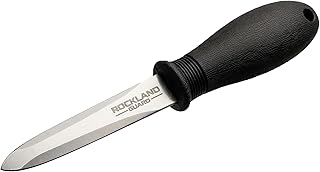
Rockland Guard Oyster Shucking Knife - 3.5” Heavy Duty 420 Stainless Steel Shucker for Clams & Shellfish - Non-Slip Ergonomic Handle Seafood Tool for Beginners, 1-Pack

Rockland Guard Oyster Shucking Knife - 3.5” Heavy Duty 420 Stainless Steel Shucker for Clams & Shellfish - Non-Slip Ergonomic Handle Seafood Tool for Beginners, 1-Pack

4.6(1K)

$8.90

View on Amazon
mid-range
OXO Good Grips Stainless Steel Non-Slip Oyster Knife

OXO Good Grips Stainless Steel Non-Slip Oyster Knife

4.7(2.7K)

$14.94

View on Amazon
premium
Dexter-Russell Sani-Safe 2.75" New Haven Oyster Knife, Curved Tip

Dexter-Russell Sani-Safe 2.75" New Haven Oyster Knife, Curved Tip

4.8(2.1K)

$17.99

View on Amazon

Choose one with a raised guard and a grippy handle. Buy a second if you plan to shuck with a friend.

Cut-resistant glove

Essential · Safety gear

Protects the hand holding the oyster from knife slips and sharp shell edges, the most common shucking injury.

budget
Schwer SlicePro ANSI Cut Resistant Gloves, Food Grade Cutting Glove for Kitchen Food Prep, Mandoline Gloves for Meat Cutting, Oyster Shucking, Fish Fillet Processing, PR1501-G, L

Schwer SlicePro ANSI Cut Resistant Gloves, Food Grade Cutting Glove for Kitchen Food Prep, Mandoline Gloves for Meat Cutting, Oyster Shucking, Fish Fillet Processing, PR1501-G, L

4.6(1.7K)

$7.63

View on Amazon
mid-range
Dowellife Cut Resistant Gloves Food Grade Level 5 Protection, Safety Kitchen Cut Gloves for Chef Oyster Shucking Mandolin Knife Butcher Meat Cutting

Dowellife Cut Resistant Gloves Food Grade Level 5 Protection, Safety Kitchen Cut Gloves for Chef Oyster Shucking Mandolin Knife Butcher Meat Cutting

4.5(15.5K)

$9.99

View on Amazon
premium
NoCry Cut Resistant Work Gloves for Women and Men, with Reinforced Fingers; Comfortable, 100% Food Grade Kitchen Cooking Hand Protection; Ambidextrous Safety Gear for Cutting; Level 5 Protection

NoCry Cut Resistant Work Gloves for Women and Men, with Reinforced Fingers; Comfortable, 100% Food Grade Kitchen Cooking Hand Protection; Ambidextrous Safety Gear for Cutting; Level 5 Protection

4.5(4.3K)

$15.79

View on Amazon

Wear it on your non-dominant hand. Check the size chart; a snug fit gives a better grip. It resists slicing, not a hard stab, so keep the knife pointed away from your hand anyway. Machine washable.

Stiff shellfish scrub brush

Recommended · Prep

Scrubbing mud and grit off the shell, especially at the hinge, keeps it out of the opened oyster.

budget
Chef'n PalmBrush Vegetable Brush, 3.5" x 3" x 1.5", Marble Gray

Chef'n PalmBrush Vegetable Brush, 3.5" x 3" x 1.5", Marble Gray

4.6(1.6K)

$8.95

View on Amazon
mid-range
MR.SIGA Fruit and Vegetable Cleaning Brush with Non Slip Comfortable Grip

MR.SIGA Fruit and Vegetable Cleaning Brush with Non Slip Comfortable Grip

4.7(3.4K)

$13.99

View on Amazon
premium
Redecker Mussel Brushes, Beechwood, 3.75 Inch, Set of 2

Redecker Mussel Brushes, Beechwood, 3.75 Inch, Set of 2

4.5(102)

$27.48

View on Amazon

Keep it for shellfish and vegetables only.

Red wine vinegar

Recommended · Ingredients

The base of a classic mignonette, the sharp shallot sauce served with raw oysters.

budget
Pompeian Gourmet Red Wine Vinegar - 16 fl oz, 473 mL

Pompeian Gourmet Red Wine Vinegar - 16 fl oz, 473 mL

4.8(3.6K)

$2.88

View on Amazon
mid-range
365 by Whole Foods Market, Red Wine Vinegar, 16.9 Fl Oz

365 by Whole Foods Market, Red Wine Vinegar, 16.9 Fl Oz

4.7(2.9K)

$3.68

View on Amazon
premium
Napa Valley Naturals Organic Red Wine Vinegar, 12.7 Ounces

Napa Valley Naturals Organic Red Wine Vinegar, 12.7 Ounces

4.6(783)

$6.87

View on Amazon

One bottle makes many batches. Champagne or white wine vinegar works too.

Whole black peppercorns

Recommended · Ingredients

Mignonette needs coarsely crushed pepper, which tastes brighter than pre-ground.

budget
Amazon Grocery, Tellicherry Whole Black Peppercorns, 3.5 Oz

Amazon Grocery, Tellicherry Whole Black Peppercorns, 3.5 Oz

4.8(4.5K)

$3.86

View on Amazon
mid-range
Tone's Whole Black Peppercorns, 2.13 Ounce

Tone's Whole Black Peppercorns, 2.13 Ounce

4.6(81)

$5.99

View on Amazon
premium
McCormick Whole Black Peppercorns, 7 oz

McCormick Whole Black Peppercorns, 7 oz

4.9(5K)

$7.33

View on Amazon

Crush them under the bottom of a heavy pan if you do not have a grinder with a coarse setting.

Coarse salt for serving and roasting

Optional · Serving

For later: a bed of coarse or rock salt holds shells level so the liquor does not spill, on a serving platter or in the oven when roasting oysters.

budget
Le Guerandais Coarse Sea Salt Gros Sel De Guerande, 28.21 oz (1 Pack)

Le Guerandais Coarse Sea Salt Gros Sel De Guerande, 28.21 oz (1 Pack)

4.7(1.6K)

$7.82

View on Amazon
mid-range
Viva Doria Pure Sea Salt, Coarse Grain, 2 lb | Ideal For Salt Grinders

Viva Doria Pure Sea Salt, Coarse Grain, 2 lb | Ideal For Salt Grinders

4.8(3K)

$9.99

View on Amazon
premium
Morton Ice Cream Salt, Rock Salt for Ice Cream Maker, 4 Pounds, Pack of 4

Morton Ice Cream Salt, Rock Salt for Ice Cream Maker, 4 Pounds, Pack of 4

4.8(1.5K)

$11.28

View on Amazon

Any coarse sea salt or food-grade rock salt works; you need a pound or two per tray. Crushed ice does the same job for raw oysters, and the salt can be reused for roasting several times.