Skip to content

Starter guide

Trail Camera Trapping

Leave a camera in the woods and see who walks by.

Trail camera trapping means strapping a small weatherproof, motion-triggered camera to a tree and leaving it alone for days or weeks. It photographs or films whatever walks past, day or night, so you get to see the foxes, deer, raccoons, owls and bobcats that vanish long before a person gets close. The fun is half detective work (reading tracks and trails to guess where animals travel) and half the surprise of opening the memory card. A complete first setup costs less than a pair of decent binoculars, and the animals are never baited or handled.

Difficulty
beginner-friendly
Startup cost
$85-$280
First result
Your first wildlife photos within a week of setting the camera
Who walked byThe camera wakes when a warm body crosses in front, day or night.
Set total$0.00
A camouflage trail camera strapped to the trunk of a spruce tree
01

What a camera trapper actually does

Scout, set, wait, read the card

Most of the hobby happens on two short walks. On the first you scout a patch of woods, a creek bank or a field edge for signs that animals pass through, pick a tree, and set the camera. On the second, a week or two later, you swap the memory card and read what happened while you were gone. A visit takes an hour or two including the walk. In between, the camera does the waiting for you: a heat-and-motion sensor wakes it when a warm body crosses in front, and infrared LEDs light the scene at night without a visible flash. At home you sort the photos, delete the empty frames, name the animals and decide whether to leave the camera where it is or try a better spot.

02

Your first set, step by step

Tick these off as you go

What you can capture in your first month

A species list for one spot

Every animal that used a single trail over four weeks, usually 5 to 10 species even near town.

A night video clip

Ten seconds of a fox, raccoon or opossum going about its business in infrared.

A who-comes-when chart

Tally the time stamps to see which animals are out at dusk, at midnight and at dawn.

A repeat visitor

One animal you can recognize on several nights by a torn ear, a scar or an antler shape.

03

How to choose a trail camera

Flash type matters most.

No-glow infrared is invisible to animals and people. Low-glow shows a faint red dot but lights the scene farther. White flash gives color night photos and startles everything. Start with no-glow or low-glow.

Trigger speed under half a second.

A slow trigger gives you photos of tails leaving the frame.

Ignore the megapixel number.

Most sensors are far smaller than the box claims and the camera scales the image up. Sample night photos in reviews tell you more.

Detection range of 60 feet or more covers a trail comfortably.

Match it to the flash range, or the camera triggers on animals it cannot light.

Standard memory cards and AA batteries.

They are cheap, sold everywhere, and easy to swap in the field.

Skip cellular for now.

Cameras that text photos to your phone need a monthly data plan and a signal in the woods. A plain card camera teaches the same skills for much less.

A built-in screen helps.

It lets you check the aim on the tree instead of guessing.

04

Where animals actually walk

Game trails

The narrow paths worn through leaves and grass. The more tracks, the better.

Water

Creek crossings, pond edges and puddles on dry ridges draw everything, birds included.

Pinch points

A log over a stream, a gap in a fence, a culvert, or the strip of cover between two fields.

Edges

Where woods meet a meadow or a marsh, animals patrol the line at dawn and dusk.

Scent posts

A stump or rock where foxes, coyotes and bobcats leave droppings gets checked by all of them.

Your own backyard

A brush pile, a compost heap or the gap under the back fence often shows more night traffic than people expect.

A single four-toed paw print pressed into smooth wet mud
A paw print in wet mud
05

Permission, privacy and wildlife rules

  • Get the landowner's permission before leaving a camera on private land, in writing if you can.
  • Public land rules vary. Some states and park systems restrict or ban unattended cameras, limit the season, or require your name and contact details on the camera. Check with the agency that manages the land before you set one.
  • Never point a camera at a path, yard, window or parking area where it will photograph people. Recording people without consent can break privacy laws, and it is the fastest way to get a camera stolen or removed.
  • Do not bait. Feeding wild animals is illegal in many states and parks, spreads disease, and teaches animals to seek out people. A good trail needs no food.
  • Stay away from dens and nests. If a camera shows young animals at a den, move it farther back or take it down.
  • Leave the site as you found it: Trim only what blocks the lens, and take down every strap when you move on.
A doe and a spotted fawn crossing a sandy track between green thickets
A doe and fawn crossing a track
06

What trips beginners up

What to expect

  • Expect empty frames. Wind, sun-warmed branches and shifting shadows trigger the sensor. A card that is three quarters empty frames is normal at first.
  • Expect blurry night photos. Infrared needs a slow shutter, so a trotting fox smears. Video often shows night animals better.
  • Expect slow weeks. Some spots produce nothing for ten days, then a bobcat. Give each location two weeks before moving.

Habits to drop

  • Do not mount it at eye level. Chest height photographs deer backs and misses everything smaller. Knee height catches both.
  • Do not check it every other day. Frequent visits push animals off the trail.
  • Do not face it east or west. Low sun triggers hundreds of washed-out photos at dawn or dusk.
  • Do not forget the clock. A wrong date makes every time stamp useless for learning when animals are active.
A small group of deer walking through dark woodland over a floor of fallen leaves
Deer moving under a dark canopy
07

Where to learn more

A young white-tailed buck walking along a dirt path at the edge of thick brush
A young buck on a dirt path

The fastest way to get good at naming animals from a blurry night frame is to look at thousands of other people's photos. Zooniverse hosts research projects that ask volunteers to identify animals in camera trap images, and it shows you the right answer as you go. Snapshot Wisconsin publishes the setup instructions it gives its own volunteers. When your camera catches something you cannot name, upload it to iNaturalist. Once you have a few hundred photos, Wildlife Insights will store and sort them and tell you which species turn up most.

08

Why the kit looks like this

The camera is the only real expense, and a budget model takes photos good enough to learn on. The running costs are batteries and cards. Lithium AAs cost more than alkalines but last months longer and keep working in freezing weather, which matters when the camera sits outside all winter. Two cards let you swap in seconds and read the full one at home. A card reader that plugs into your phone lets you see the photos while you are still standing at the tree, so you can fix a bad aim the same day. The cable lock only earns its place on land that other people use. The tracks guide and the adjustable mount make your placements better, but you can add them after your first few card pulls.

Close-up of a split hoof print pressed deep into mossy mud
A hoof print in mossy mud
09

Pack for the first set

Compare the options on each line, then set your tiers and check out from the cart. Clicking a card selects it there, and clicking the selected card again takes that line out. The cable lock is an add-on for public land and starts out of the kit, and so does the optional mount.

EssentialCore equipment

Trail camera

This is the whole hobby: a weatherproof camera that wakes on heat and motion and photographs animals day and night while you are somewhere else.

budget
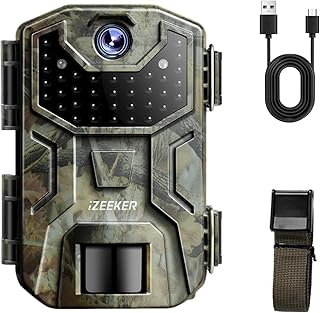
iZEEKER Trail Camera, HD Game Camera with 940nm No Glow Night Vision Motion Activated 0.2s Trigger Time, Hunting Camera No WiFi, IP66 Waterproof for Wildlife Monitoring Outdoor Security Deer Scouting

iZEEKER Trail Camera, HD Game Camera with 940nm No Glow Night Vision Motion Activated 0.2s Trigger Time, Hunting Camera No WiFi, IP66 Waterproof for Wildlife Monitoring Outdoor Security Deer Scouting

4.2(1.9K)

$33.99

View on Amazon
mid-range
GardePro E5S Non-Cellular Trail Camera, 64MP Photo & 1296P HD Video

GardePro E5S Non-Cellular Trail Camera, 64MP Photo & 1296P HD Video

4.4(799)

$49.99

View on Amazon
premium
Browning Trail Cameras Recon Force Elite HP5 Ultra (Non-Cellular)

Browning Trail Cameras Recon Force Elite HP5 Ultra (Non-Cellular)

4.6(3)

$159.99

View on Amazon

Pick a non-cellular model that takes standard memory cards and AA batteries. Most include a mounting strap.

EssentialConsumables

SD memory card (32GB)

Trail cameras rarely include a card. Two let you swap the full one for an empty one at the tree and read the photos at home.

budget
SANDISK 32GB Ultra SD Memory Card, Up to 120MB/s Read Speeds, UHS-I

SANDISK 32GB Ultra SD Memory Card, Up to 120MB/s Read Speeds, UHS-I

4.7(79.1K)

$19.99

View on Amazon
mid-range
Stealth Cam 32 GB SD Memory Card

Stealth Cam 32 GB SD Memory Card

4.6(468)

$22.01

View on Amazon
premium
SANDISK 32GB Extreme PRO SD Memory Card, Up to 100MB/s Read Speeds, UHS-I

SANDISK 32GB Extreme PRO SD Memory Card, Up to 100MB/s Read Speeds, UHS-I

4.8(70.6K)

$34.47

View on Amazon

Check the camera's maximum card size and whether it takes a full-size or micro card before ordering. 32GB holds thousands of photos.

EssentialConsumables

Lithium AA batteries

Most trail cameras run on eight AAs and do not include them. Lithium cells last several months and keep working below freezing, where alkalines fade fast.

budget
EBL 8 Pack 3000mAh 1.5V Lithium AA Batteries - Non-Rechargeable High Performance Super Ⅰ AA Lithium Batteries Constant Volt for Cameras, High-Tech Devices (Non-Rechargeable Batteries)

EBL 8 Pack 3000mAh 1.5V Lithium AA Batteries - Non-Rechargeable High Performance Super Ⅰ AA Lithium Batteries Constant Volt for Cameras, High-Tech Devices (Non-Rechargeable Batteries)

4.4(342)

$11.29

View on Amazon
mid-range
Granicell 8-Pack Lithium AA Batteries

Granicell 8-Pack Lithium AA Batteries

4.5(1.9K)

$14.24

View on Amazon
premium
Energizer Ultimate Lithium AA Batteries (8 Pack), 1.5V Lithium Double A Batteries

Energizer Ultimate Lithium AA Batteries (8 Pack), 1.5V Lithium Double A Batteries

4.7(74.7K)

$15.99

View on Amazon

Count the battery slots on the camera you choose and buy enough to fill it. Do not mix old and new cells.

RecommendedAccessories

Phone SD card reader

Plugs a memory card into your phone so you can see what the camera caught while you are still at the tree, and fix a bad aim before you leave.

budget
SZHAIYIJIN SD Card Reader for iPhone, Memory Card Reader with USB Camera Adapter Plug and Play Trail Game Camera Viewer Supports SD and TF Card MicroSD Card Adapter for iPad No App Required

SZHAIYIJIN SD Card Reader for iPhone, Memory Card Reader with USB Camera Adapter Plug and Play Trail Game Camera Viewer Supports SD and TF Card MicroSD Card Adapter for iPad No App Required

4.4(14.4K)

$9.99

View on Amazon
mid-range
SD Card Reader for iPhone/ipad/Android/Mac/Computer/Camera,4 in1 Micro SD Card Reader Trail Camera Viewer, Portable Memory Card Reader SD Card Adapter for SD and TF Cards(White)

SD Card Reader for iPhone/ipad/Android/Mac/Computer/Camera,4 in1 Micro SD Card Reader Trail Camera Viewer, Portable Memory Card Reader SD Card Adapter for SD and TF Cards(White)

4.3(20.3K)

$15.99

View on Amazon
premium
SD Card Reader for Android - Type C USB Trail Camera Viewer by BoneView - Backup Play Save and Share Deer Hunting Photo & Video from Game Cam Memory Chips on Most USB-C Smart Phones

SD Card Reader for Android - Type C USB Trail Camera Viewer by BoneView - Backup Play Save and Share Deer Hunting Photo & Video from Game Cam Memory Chips on Most USB-C Smart Phones

4.0(5.9K)

$22.95

View on Amazon

Match the plug to your phone's charging port before you order: some readers fit only one type. A laptop with a card slot does the same job at home.

RecommendedLearning

Animal tracks field guide

Placing a camera well means reading tracks, droppings and trails. A pocket guide tells you which animal left the sign and where to aim.

budget
Animal Tracking: A Folding Pocket Guide to Animal Tracking & Behavior (Outdoor Skills and Preparedness)

Animal Tracking: A Folding Pocket Guide to Animal Tracking & Behavior (Outdoor Skills and Preparedness)

4.4(71)

$7.95

View on Amazon
mid-range
A Field Guide to Animal Tracks (Peterson Field Guides)

A Field Guide to Animal Tracks (Peterson Field Guides)

4.5(35)

$8.99

View on Amazon
premium
A Field Guide to Mammal Tracking in North America

A Field Guide to Mammal Tracking in North America

4.6(33)

$11.35

View on Amazon

A regional or pocket-size guide is easier to carry on a scouting walk than a full reference.

Add-on: Public LandSecurity

Trail camera cable lock

On land other people walk, theft is the most common way to lose a camera. A cable through the housing and around the tree stops a casual grab.

budget
Master Lock 6' Python Cable Lock for Trail Cameras, Kayaks 8417D

Master Lock 6' Python Cable Lock for Trail Cameras, Kayaks 8417D

4.6(9.4K)

$10.32

View on Amazon
mid-range
Master Lock 6-Foot Python Cable Lock, Outdoor, Weather-Resistant, 8418D

Master Lock 6-Foot Python Cable Lock, Outdoor, Weather-Resistant, 8418D

4.7(8.4K)

$18.48

View on Amazon
premium
Spypoint CLM-6FT Six-Foot Long Trail Camera Coated Cable Lock Steel Cable Lock for securing Scouting Cameras Fits Most Trees and All Cameras Comes with Two Keys

Spypoint CLM-6FT Six-Foot Long Trail Camera Coated Cable Lock Steel Cable Lock for securing Scouting Cameras Fits Most Trees and All Cameras Comes with Two Keys

4.3(211)

$24.99

View on Amazon

Check that the cable fits through the lock loop on your camera. It deters, it does not make the camera theft-proof.

OptionalAccessories

Adjustable trail camera mount

For later. A strap alone points the camera wherever the trunk leans. A swivel mount lets you tilt it down a slope or onto a low trail when the right tree is crooked.

budget
HME Economy Trail Camera Holder with 360-Degree Camera Compact Sturdy Design Easy Installation & Versatile Compatibility

HME Economy Trail Camera Holder with 360-Degree Camera Compact Sturdy Design Easy Installation & Versatile Compatibility

4.7(2.6K)

$9.10

View on Amazon
mid-range
Trail Camera Mount Strap, 60" Heavy Duty Nylon with 360° Adjustable Ball Head, Universal 1/4"-20 Thread for Game Cams & Solar Panels (Reveal, Moultrie, Spypoint)

Trail Camera Mount Strap, 60" Heavy Duty Nylon with 360° Adjustable Ball Head, Universal 1/4"-20 Thread for Game Cams & Solar Panels (Reveal, Moultrie, Spypoint)

5.0(2)

$12.99

View on Amazon
premium
HME Strap-On Trail Camera Holder

HME Strap-On Trail Camera Holder

4.3(73)

$27.59

View on Amazon

The cheapest option here screws into the trunk, so keep it for your own trees. Use a strap-on mount anywhere else. Most cameras have the standard tripod thread these use.